

Overview
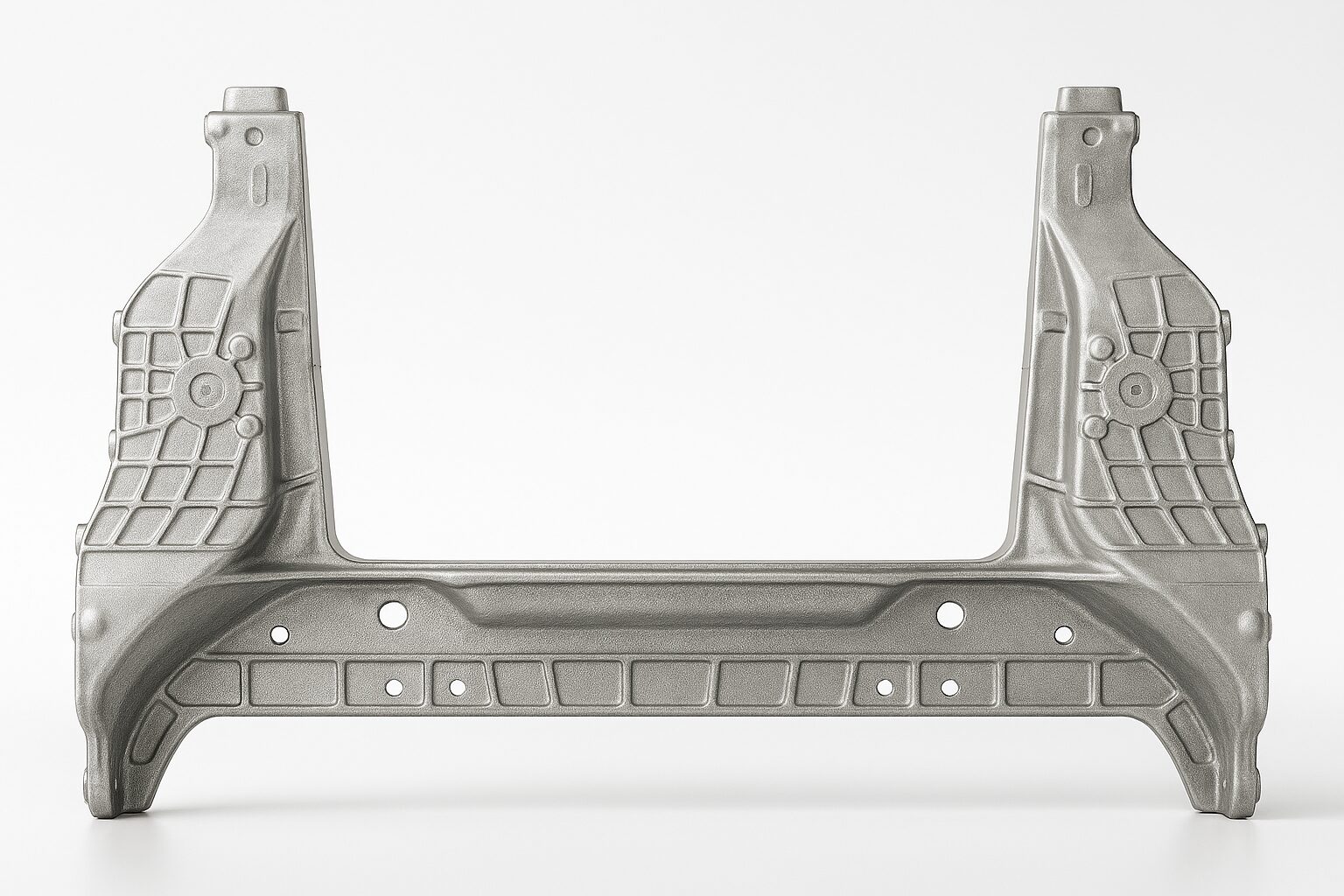
In early 2024, a global automotive manufacturer presented Grainger and Worrall with a challenge that industry veterans considered impossible. They needed large structural aluminium underbody castings, delivered in four months.
These Gigacastings are safety-critical structural components that form the majority of the vehicle’s underside. Any deficiency in casting integrity, material stiffness appropriate to energy absorption, dimensional accuracy, or material properties directly compromises crash performance and vehicle stiffness.
The customer had sourced similar components previously, but rising expectations around delivery speed and casting quality created a new challenge.
They needed a supplier capable of solving long‑standing technical issues, accelerating development, and delivering production‑ready castings before hard tooling became available.
Grainger & Worrall delivered 16 production-ready castings in four months, achieving fill speeds 15× faster than the industry standard and proving that gravity sand casting could compress development cycles enough to fit through the industry’s shrinking prototyping window. It was a process that had never been achieved before.
The Challenge
Why Speed Mattered – Racing Against the Die Casting Press
For this customer, speed was not a preference – it was existential. Their development model relies on producing as many specification-compliant parts as possible before their die casting presses are completed. Once hard tooling is ready, the window for prototype supply closes immediately.
This creates a race:
- Late design freeze: customer finalised specifications in late January, leaving minimal development time
- Grainger & Worrall must rapidly develop a casting process, using tool-less techniques to establish baseline process parameters
- Zero tolerance for delays: Parts had to be validated and supplied before hard tooling arrived in June
- Volume under pressure: Every rejected casting reduced the customer’s test allocation
This programme demanded maximum throughput in minimum time, with no compromise on structural integrity.
Speed alone wasn’t enough. The customer also demanded casting quality that conventional rapid prototyping methods had failed to deliver in previous programmes.
Technical Requirements: Match Die Casting Quality at Prototype Speed
The customer required Grainger and Worrall to:
- Present casting attributes simulation to that of high-pressure die cast
- Develop a casting process for large, highly complex aluminium underbody structures
- Improve on the performance of the previous year’s programme
- Deliver as many parts as possible before hard tooling was ready
- Achieve unprecedented fill times for gravity sand casting
Traditional gravity sand castings of this scale typically fill too slowly. The new programme demanded a new paradigm for high mass-flow filling, able to cast large, thin-walled parts without loss in metal quality
Why This Had Never Been Done Before
The project confronted genuine technological unknowns that no one in the industry had solved. Three barriers stood in the way:
1. Simulation limitations
Without fast, accurate simulation, iterative optimisation was impossible, and the customer’s deadline wouldn’t wait.
- Standard sand‑casting simulations were too slow and not sufficiently accurate at high velocities.
- A typical model contained ~22 million cells and required ~175 hours per iteration, making iterative optimisation impractical.
- Existing models did not accurately predict air‑pressure behaviour at extreme fill speeds.
2. Unexpected mould behaviour
Although sand moulds are permeable, at very high velocities they behave more like sealed dies. This creates:
- Localised pressure zones
- Air entrapment
- Oxidation defects
- Flow-off behaviour that cannot be predicted using standard models
These defects had derailed previous programmes. Without understanding their true cause, no solution was possible.
3. No known industry solution
Competent professionals could not deduce a solution without extensive experimentation. The combination of component size, required fill speeds, structural complexity, and tight specification limits created a genuine engineering challenge. Traditional gravity sand casting expertise couldn’t solve this. Die casting expertise didn’t apply yet. Grainger and Worrall needed to invent a new approach
The Breakthrough: Turning Simulation on Its Head
Faced with simulation tools too slow for iteration and defect mechanisms no one understood, Grainger and Worral’s engineering team made an unconventional decision that would prove critical. To overcome the simulation bottleneck, Grainger & Worrall adopted an unconventional approach: using a die‑casting simulation module to model a gravity sand‑casting process.
Why this worked
- The die‑casting module used a tag mesh, quartering the cell count.
- Simulation time dropped from 175 hours to ~70 hours.
- Faster iteration enabled eight full simulations within the development window.
- The model produced more accurate predictions of air‑pressure behaviour at extreme velocities.
What this revealed
The simulations exposed the true mechanism of air entrapment and guided the development of:
- New flow-off features
- Modified gating strategies
- Improved venting behaviour
- Reduced oxidation defects
Theory is one thing. Casting molten aluminium at unprecedented speeds is another. The true test came in February when the first moulds were poured.
Validation
When physical casting began:
- The first parts produced after simulation required minimal repair
- Flow behaviour matched simulation predictions
- Defect levels dropped significantly
- External X‑ray and dimensional inspection confirmed compliance – the first-article success rate was dramatically higher than previous programmes.
This validated both the modelling approach and the process changes.
With simulation validated and the process proven, Grainger and Worrall moved into full production mode. The customer’s deadline hadn’t moved, and the clock was ticking.
Engineering Execution – The Race Against Time
The Timeline: January to June
The project progressed rapidly from initial engagement in January to full supply by June.
Key milestones
- Early February: Simulation work begins – 175-hour models replaced with 70-hour iterations
- Mid‑February: First digital sand-printed moulds cast – simulation predictions meet molten metal
- Early March: First specification-compliant part produced – just 6 weeks from program start
- June: Full supply achieved – 16 production-ready castings delivered before the window closed
Timeline discipline is meaningless without quality. The production statistics reveal just how robust the final process became.
Production outcomes
A 73% production-ready rate, achieved while setting industry speed records, demonstrated the robustness of the final process.
Grainger & Worrall produced:
- 22 total castings
- 16 production‑ready parts
- Only 2 scrap castings
- 4 engineering samples used for cut‑up and correlation
The low scrap rate, achieved despite unprecedented fill speeds, demonstrated the robustness of the final process. The programme’s success can be measured in multiple dimensions, each one representing a significant industry advancement.
Results That Redefined What’s Possible
The programme delivered several significant technical breakthroughs:
1. Unprecedented fill speeds
- Achieved 5‑second and 4‑second fill times (industry standard for this time is 75+ seconds)
- Flow velocities up to 15× faster than standard sand‑casting practice
Speed without integrity is worthless. The real achievement was maintaining quality while pushing velocity limits
2. Improved casting integrity
- Air‑entrapment and oxidation defects were significantly reduced – the high-velocity pour mechanisms that had plagued previous programmes were now controlled by simulation-guided gating.
- Flow-off redesigns informed by advanced simulation
- First‑part quality far higher than previous programmes
Better castings delivered faster meant the customer could do more with their prototype allocation. But the development cycle itself also transformed
3. Accelerated development cycle
- Simulation time reduced from 175 hours to ~70 hours
- Eight full simulations completed within the development window
- The first specification‑compliant part produced six weeks from the programme start.
4. Delivered under extreme time pressure
- All required parts supplied before hard tooling became available
- All scientific and technical uncertainties resolved within the programme window
All of these technical achievements served a single business goal: deliver complex Gigacastings exactly to required specification before the window closed.
Conclusion: What This Means For Rapid Prototyping
This project pushed the boundaries of what is considered possible in gravity sand casting. By combining advanced simulation techniques, rapid experimentation and disciplined engineering, Grainger & Worrall delivered large, complex structural castings at unprecedented speeds without compromising integrity.
The successful development and supply of next‑generation underbody castings demonstrate Grainger & Worrall’s ability to:
- Solve high‑pressure engineering challenges
- Compress prototype development cycles to match accelerating tooling schedules
- Deliver production‑ready aluminium castings when time is measured in weeks, not months
- Meet exact customer specifications even under extreme time constraints
As die casting continues to accelerate, rapid prototyping suppliers face a choice: compress development cycles or become obsolete. Grainger & Worrall chose innovation
All of these technical achievements served a single business goal: deliver before the window closed. This wasn’t just one successful project, it was proof that rapid prototyping can keep pace with shrinking development windows. As die casting tooling lead times compress, prototype suppliers must deliver faster or become irrelevant. Grainger and Worrall proved gravity sand casting can evolve to match the new reality.
Grainger & Worrall’s rapid prototyping capabilities combine advanced simulation, iterative development, and deep metallurgical expertise to deliver production-ready castings faster than conventional methods allow.
Facing a complex casting challenge with shrinking prototype window? Speak with a member of our team
Frequently Asked Questions
Q: How fast can gravity sand casting fill large structural components?
A: Grainger & Worrall achieved 4-5 second fill times for large EV underbody gigacastings—15× faster than the industry standard of 75+ seconds.
Q: Can gravity sand casting match die casting quality for prototypes?
A: Yes. This program demonstrated that advanced simulation and process control can deliver die-casting-quality mechanical properties and dimensional accuracy using toolless gravity sand casting methods.
Q: How quickly can rapid prototyping deliver production-ready castings?
A: Grainger & Worrall delivered the first specification-compliant casting in six weeks and completed full supply of 16 production-ready parts in four months.
*Please note: this image is an AI-generated visualisation of a casting component similar in form and function to the actual part. Due to a non-disclosure agreement with the customer, the real component cannot be shown.