


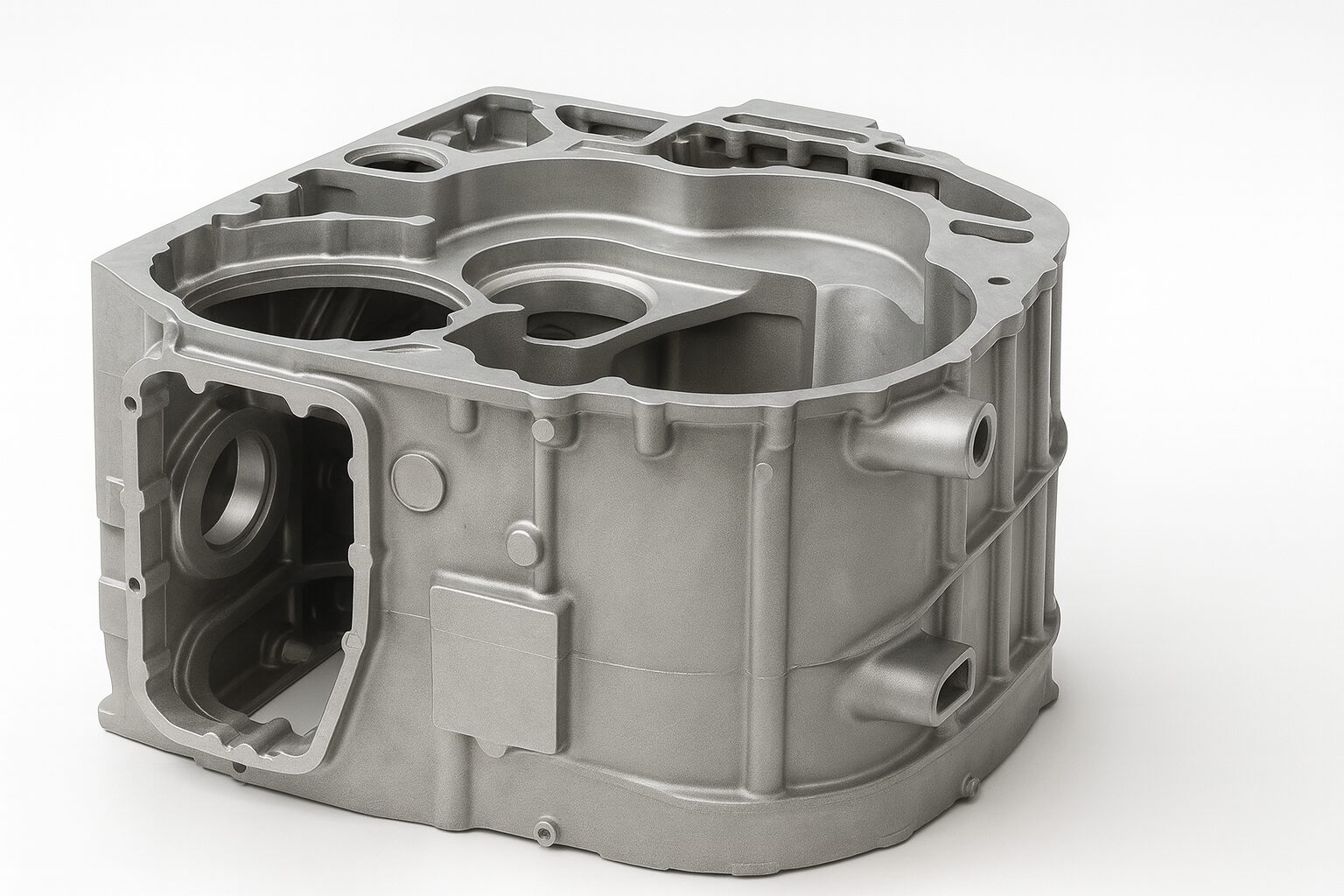
*Please note: this image is an AI-generated visualisation of a casting component similar in form and function to the actual part. Due to a non-disclosure agreement with the customer, the real component cannot be shown.
Overview
In late 2024, a major defence manufacturer approached Grainger and Worrall with a problem that had defied solution for over a decade. Their mission-critical aluminium engine component, responsible for structural integrity and sealing performance in military applications, was failing at a 50% scrap rate. The incumbent supplier had struggled for ten years to produce it reliably. Production volumes were constrained. Programme costs were unsustainable.
The customer needed a new supplier who could not only solve the technical problems but also deliver a fully validated, military-grade casting in nine months, one-third of the typical 24-month development cycle for defence-grade components.
The incumbent supplier’s decade-long struggle told the story: 50% scrap rates driven by recurring integrity issues, core positioning errors, and dimensional drift. Half of every production run was scrapped, which made the programme commercially unviable and capped production volumes. The technical challenges were genuine. The component demanded defence-grade structural integrity, multi-core assembly precision, and zero tolerance for sealing defects. Commercial casting standards weren’t close to sufficient
Grainger and Worrall were asked to step in and deliver what the previous supplier couldn’t: a fully validated, military-grade component that met stringent inspection specifications, and do it in nine months, not the typical 24. Failure would delay the customer’s production schedule. Success would require solving technical problems that had persisted for a decade while moving three times faster than industry norms. There was no margin for error.
Understanding why this programme demanded revolutionary speed and precision requires understanding what makes defence-grade aerospace components different and why the incumbent supplier failed.
The Challenge
Understanding why this programme demanded revolutionary speed and precision requires understanding what makes defence-grade castings different and why the incumbent supplier failed.
The project presented two intertwined challenges:
Challenge 1: Extreme Technical Complexity
The component required:
- Defence‑grade structural integrity: Commercial casting standards were insufficient; the part had to withstand military vehicle operating conditions, including shock, vibration, and extreme temperatures
- Tight dimensional tolerances: Sub-millimeter accuracy required across dozens of features to ensure proper sealing and mechanical fit
- Stringent inspection specification: Every casting subject to dimensional verification, X-ray inspection, and mechanical testing beyond commercial norms
- 45-piece multi-core assembly: The internal geometry required 45 individual sand cores to be positioned with precision; any misalignment caused dimensional drift and inspection failure
- Zero tolerance for defects: A single leak path, porosity cluster, or sealing defect meant rejection—no rework possible after machining
An equivalent component did not exist in the commercial automotive market. Defence-grade castings must perform far beyond commercial equivalents in accuracy, durability, and mechanical integrity. These challenges contributed to the high scrap of the incumbent supplier.
Challenge 2: Compressed Development Window
In aerospace and defence programmes:
- Development cycles typically span 18–24 months: Extended simulation phases, sequential engineering steps, and late-stage certification are standard
- Design freezes are absolute: Once validation testing begins, no design modifications are permitted – every iteration must be right
- Certification occurs only after machining and full assembly
- Any defect discovered late in the process requires extensive rework
The customer needed a validated component in nine months, with no scope for design modification once testing began. This meant G&W had to:
- Develop a new casting process
- Validate it through destructive and non‑destructive testing
- Deliver all required components
- Achieve near‑zero scrap
- Meet military‑grade acceptance criteria
All within a timeline that aerospace and defence engineers would normally consider impossible. The incumbent supplier had taken ten years and still hadn’t achieved it.
3. Why This Was Genuinely Hard: A decade of 50% Scrap
The incumbent supplier’s decade-long struggle with 50% scrap rates was not a failure of competence; it was evidence of genuine technical difficulty. Multiple sand cores, tight tolerances, and defence-grade inspection standards created a complexity that conventional casting methods couldn’t reliably solve. Grainger and Worrall’s task was not simply to ‘do it better. ‘ It was to achieve what had not been achieved in ten years of trying and do it three times faster than the typical 24-month defence qualification cycle. The technical bar was extraordinarily high. The timeline was extraordinarily compressed. Both had to be met simultaneously
Scientific and Technological Challenges
1. Multi-Core Assembly Complexity at Defense-Grade Tolerances
The component’s internal geometry required a 45-piece sand core assembly. Each core had to be positioned with sub-millimetre accuracy. Even minor assembly variations caused:
- Dimensional drift beyond inspection tolerances
- Core shift during metal pouring
- Wall thickness variation leading to mechanical property failures
- Sealing surface defects
Commercial castings tolerate some dimensional variation. Defence-grade castings do not. The core assembly had to be perfectly repeated.
2. Certification Timelines Incompatible with Nine-Month Delivery
Traditional defence casting development follows a rigid sequence:
- Extensive simulation
- First physical samples
- Destructive testing and analysis
- Process refinement
- Final qualification after machining and assembly testing
This sequential approach is incompatible with a nine-month timeline. Grainger and Worrall couldn’t simply ‘work faster’; the entire development model had to change. But changing the model risked missing defects that only appear in late-stage testing.
3. Late Discovery of Defects = High-Cost Iteration
Defence-grade components are certified only after full machining, assembly, and endurance testing. This means:
- Casting defects are discovered after significant machining investment
- Each iteration costs weeks and substantial tooling expense
- Design changes are not permitted once testing begins
- A single late-stage failure can derail the entire programme.
The challenge was not whether the part could be cast; it was whether it could be cast accurately, repeatedly, and validated fast enough to meet the customer’s production schedule.
Solving these challenges required abandoning conventional aerospace development methodology entirely.
Breakthrough In Process Development
Faced with technical problems that had defied solution for a decade and a timeline that was one-third of industry standard, Grainger and Worrall made a radical decision: abandon the sequential development model entirely.
Instead of simulation → sampling → testing → refinement, G&W ran all four activities in parallel from day one. This hybrid methodology was fundamentally different from aerospace convention and essential to compressing 24 months into nine.
The Hybrid Methodology
- Advanced simulation
- Early physical sampling
- Iterative destructive testing
- Continuous feedback into the virtual model
This broke from industry convention, which typically separates simulation and physical trials into long sequential phases.
Key elements of the approach
- Advanced simulations ran continuously (24-hour turnaround per iteration)
- Physical mould packs produced far earlier than conventional practice, accepting the cost and risk to accelerate learning
- Every casting underwent X-ray, CT scanning, and tensile testing immediately
- Findings fed directly back into simulation models in real-time
- Seven complete development cycles executed within nine months (vs. typical 1-2 cycles in 24 months)
Why This Worked
- Accelerated failure discovery: Defects found in weeks, not months
- Rapid convergence: Each cycle refined both virtual and physical processes
- Risk mitigation through iteration: Seven chances to get it right instead of one high-stakes attempt
- Validation confidence: By cycle seven, simulation and physical results aligned precisely
The Cost: This approach required significant upfront investment in printed moulds, destructive testing, and simulation resources. But it was the only path to nine-month delivery.
Engineering Execution
With the hybrid methodology defined, execution became a race against the calendar. Every week mattered.
The project progressed through two major phases:
Phase 1: Prove the Concept (Feb–Mar 2025)
The first two months focused on validation:
- Initial simulation runs identified high-risk failure modes
- Printed mould packs created
- Dimensional validation using GOM analysis
- Early destructive testing to identify failure modes
- Simulation Models updated with real-world data
Result: By the end of March, G&W had identified the root causes of the incumbent’s failures and had a path to a solution.
Phase 2: Hybrid Development and Accelerated Production (Apr–Oct 2025)
This phase broke from aerospace convention entirely. While continuing iterative development, G&W simultaneously supplied parts under engineering concession.
- 40 parts produced under concession to fast‑track customer acceptance
- Iterative testing and redesign continued in parallel
- Simulation and physical sampling refined each other
The Stakes Were High: If late-stage testing revealed fundamental issues, the programme would fail. But the timeline demanded this approach sequential development wouldn’t fit in nine months.
By November, the first fully built component passed all military‑grade acceptance tests
This included:
- Dimensional accuracy to inspection specification
- Structural integrity verified through destructive testing
- Mechanical performance met requirements
- A 40‑hour engine test – passed
- Full strip‑down inspection – no defects found
The validated part met the customer’s inspection specification on the first qualification attempt.
Results
The programme delivered several significant achievements and showed that through methodology changes decade-old problems can be solved:
1. Industry‑breaking lead time
Nine months from kickoff to qualified part, one-third of the typical 24-month defense casting development cycle. This was not simply ‘working faster.’ It required a fundamentally different engineering methodology that compressed simulation, sampling, testing, and refinement into parallel workstreams instead of sequential phases.
Impact: Customers’ production schedule remained on track. Production remained on time.
2. From 50% Scrap to Near‑Zero Scrap
Grainger and Worrall’s hybrid development methodology which consisted of seven iterative cycles combining simulation and physical validation, identified and eliminated the root causes:
- Core positioning variations eliminated through refined assembly fixtures
- Dimensional drift controlled through simulation-guided gating design
- Mechanical property consistency achieved through optimized thermal management
Impact: The part became commercially viable for the first time. The customer could scale production without cost-prohibitive scrap losses.
3. Validated Military‑Grade Performance
Full defence-grade qualification achieved on first attempt:
The component passed:
- Dimensional inspection
- Structural integrity checks
- Mechanical performance tests
- A 40‑hour engine endurance test
- Full strip‑down analysis
4. A new benchmark for defence‑grade sand casting
The hybrid simulation‑plus‑sampling approach created a validated methodology for delivering highly complex, multi-core defence grade castings with tight tolerance components, accelerated qualification timelines (9 months vs 24 months), with near-zero scrap rates in production. This is not a one off success. It’s a repeatable process that has redefined defence casting development.
Conclusion
This project demonstrates that decade-old technical problems are not unsolvable, they simply require different methodologies.
By abandoning conventional sequential development in favour of parallel simulation, sampling, and testing, Grainger and Worrall delivered in nine months what the incumbent supplier could not achieve in ten years:
- A transmission casting meeting military specification
- Near-zero scrap where 50% rejection rates had been the norm
- First-attempt qualification success
- A commercially viable manufacturing process
- All delivered three times faster than aerospace industry standards
This case study reinforces G&W’s ability to:
- Solve technical challenges that have defied industry solution
- Compress defence and aerospace qualification cycles from years to months
- Deliver zero-defect castings in the most demanding applications
- Make previously uneconomical programmes commercially viable
As defence programmes demand faster delivery without compromising on performance, suppliers face a choice: continue with long sequential development cycles or adopt hybrid methodologies that compress timelines while maintaining, or exceeding, qualification standards.
Facing a complex casting challenge with shrinking prototype window? Speak with a member of our team
Frequently Asked Questions
Q: How long does defence-grade casting qualification typically take?
A: Aerospace and defence casting development typically requires 18-24 months due to sequential simulation, sampling, testing, and certification phases. G&W’s hybrid methodology compressed this to 9 months.
Q: What causes high scrap rates in complex defence castings?
A: Multi-core assembly variations, dimensional drift during pouring, and tight military inspection tolerances create inherent difficulty. G&W’s seven-cycle iterative approach identified and eliminated root causes that had persisted for over a decade.
Q: Can rapid development compromise defence-grade quality?
A: No. G&W’s hybrid methodology achieved first-attempt military qualification, faster than conventional methods while maintaining full defence-grade performance standards.